
Detection vs Response:
What’s Your Weakest Link?
Cyber threats are an unavoidable reality of doing business in today’s ever-changing digital landscape. In fact, according to the UK Government’s Cyber Security Breach Survey of 2025/2026, 43% of UK businesses have been targeted by a cyber attack in the past 12 months. The results of the survey suggest that only approximately 20 to 25% of all targeted businesses were prepared to respond effectively.
Statistically speaking, chances are high that attackers will attempt to gain access to your organisation’s systems, data, or users. When this moment comes, it’s vital that your team’s cyber security solutions are already not only in place, but tried and tested.
True cyber resilience is not measured by the number of threats detected. It is measured by your organisation’s ability to:
- Detect threats quickly and accurately,
- Respond decisively and contain risk,
- Recover efficiently with minimal disruption,
- Enable people, processes, and technology to work together seamlessly.
Cyber Resilience Requires Balance
Organisations that strike the right balance between Detection and Response are better positioned to reduce risk and minimise disruption.So, it’s worth asking the question:
If a critical security incident occurred today, would your team be confident in its ability to respond quickly, effectively, and consistently?
If the answer isn’t a clear “yes”, you’ve likely identified your weakest link.
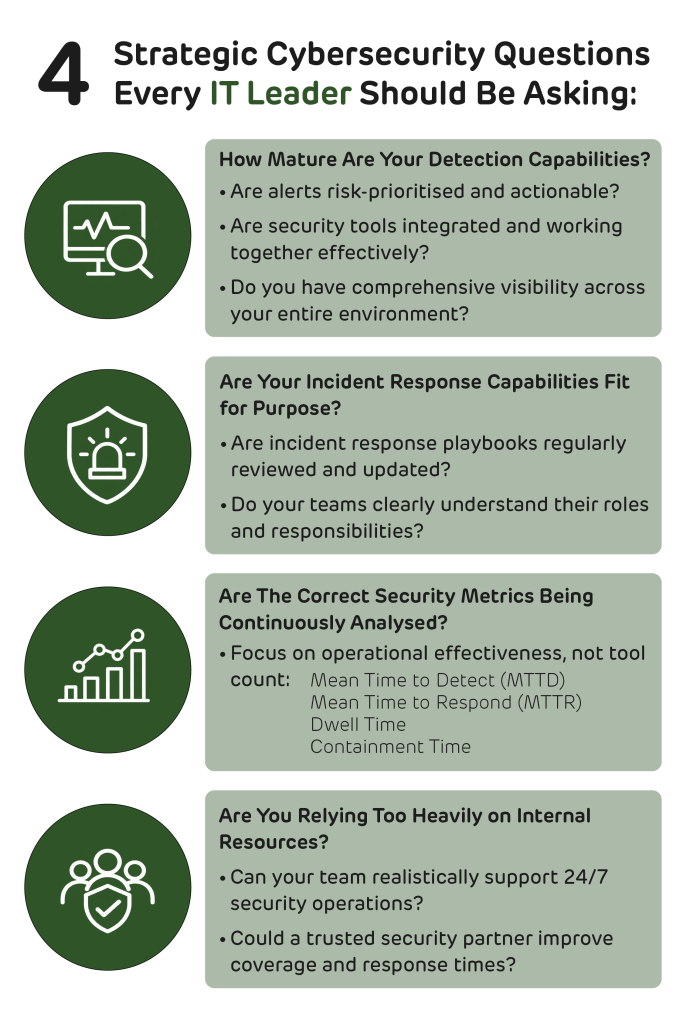
And this raises a critical question that every IT leader should be asking:
What happens after a threat is detected?
Many organisations continue to invest heavily in threat detection.
More alerts. More dashboards. More tools promising greater visibility across your systems. However, when a serious security incident occurs, visibility alone isn’t enough. Detecting a threat is only part of the equation. What really matters is how quickly and effectively you can respond.
The organisations managing cyber risk most effectively aren’t always those with the largest security stacks, they’re the ones that can respond quickly, decisively, and consistently when a security incident occurs.
Detection Is Only Half the Story
Modern detection technologies have transformed cybersecurity. AI-driven analytics, behavioural monitoring, and threat intelligence now enable organisations to identify suspicious activity faster and with greater accuracy than ever before.
However, even the most sophisticated security tools have limitations. Many IT and security teams continue to face challenges such as:
- Alert fatigue caused by overwhelming volumes of notifications,
- False positives that consume valuable time and resources,
- Security tools operating in silos, creating visibility gaps,
- A shortage of skilled cybersecurity professionals,
- Increasingly complex attack methods that make threat prioritisation more difficult.
As a result, for many organisations, identifying threats is no longer the primary challenge. The real challenge is in the response: not just in terms of speed, but effectiveness.
Detection provides visibility into potential threats. Response determines whether those threats are contained before they impact your organisation.

The Security Gap Organisations often Overlook
One of the most common misconceptions in cybersecurity is that improving detection automatically strengthens security.
This is where the gap between Detection and Response emerges, and where cyber risk often increases.
Common causes include:
- Disconnected security technologies that limit visibility and collaboration ,
- Manual, time-consuming investigation and response processes,
- Inconsistent visibility across environments,
- Shortages of experienced security analysts,
- Delayed decision-making during critical incidents,
- Limited or non-existent 24/7 monitoring capabilities.
When these challenges exist, even sucessful threat detections can remain unresolved for longer than they should, giving attackers valuable time to move laterally, escalate privileges, exfiltrate data, or disrupt operations.For the modern organisation, the real question is:
Can your team contain, investigate, and remediate a threat before it causes operational, financial, or reputational damage?
The organisations that answer “yes” are typically those that have invested not only in detection capabilities, but also in the people, processes, and technologies required to respond effectively.
Ready to Close the Gap?
At NG-IT, our team utilises decades of expertise to help organisations strengthen their cyber resilience.
From improving visibility and accelerating response times to strengthening operational resilience, we provide tailored solutions that fit the specific needs of your organisation, combined with the continued support of a team that will get you to better, faster.
Let’s start the conversation :
Threat response is essential to your organisation. Getting you the best solution is essential to us.